
Introduction
Choosing the right windows can make a significant difference to your home’s appearance, comfort, and functionality. Among the many architectural window styles available, bay windows and bow windows are two popular choices for homeowners who want more natural light, attractive views, and additional interior space.
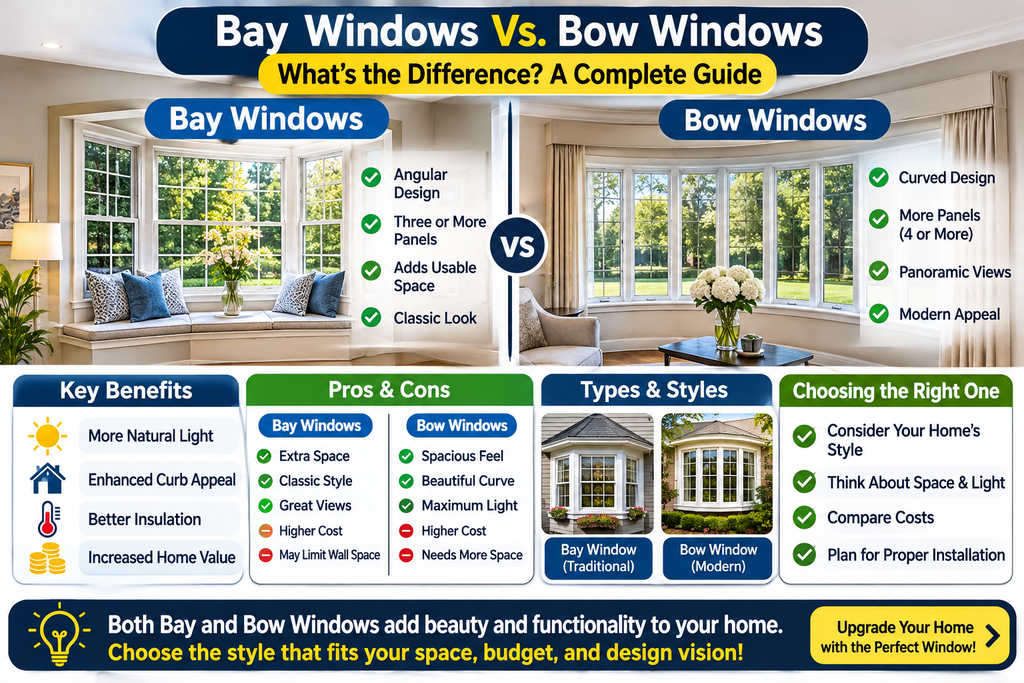
Although these window styles share several benefits, their designs and construction are different. Bay windows usually feature an angular shape with three or more sections, while bow windows have a curved appearance created by several connected window panels.
Both styles can enhance a property’s architectural character, but the right choice depends on your available space, budget, home design, and personal preferences.
In this guide, we will explore the differences between bay and bow windows, their advantages and disadvantages, design options, materials, installation requirements, and maintenance considerations.
What Are Bay Windows?
Bay windows are projecting window structures that extend outward from the exterior wall of a building. They usually consist of three window sections arranged at different angles, although some designs include additional panels.
The center section is often larger, while the side windows are positioned at an angle to create a distinctive architectural shape.
One of the main advantages of bay windows is the additional interior space they can create. Homeowners often use this area for a comfortable window seat, decorative displays, reading corners, or indoor plants.
Main Features of Bay Windows
- Usually feature three or more window panels.
- Have an angular or polygonal design.
- Extend outward from the main wall.
- Allow natural light to enter from multiple directions.
- Can create additional usable interior space.
- Complement both traditional and modern homes.
Popular Bay Window Designs
Bay windows are available in several designs to match different architectural styles.
Traditional Bay Windows: These often feature wooden frames, decorative details, and classic proportions. They are commonly used in traditional and Victorian-style homes.
Modern Bay Windows: Contemporary designs usually feature clean lines, larger glass panels, and minimal decorative elements.
Angled Bay Windows: These windows have clearly defined angled sides, creating a distinctive projection from the building.
Large Bay Windows: Larger designs can create an attractive seating area and provide wider outdoor views.
Advantages of Bay Windows
Bay windows offer several practical and aesthetic benefits.
1. More Natural Light
Because bay windows have multiple glass sections positioned at different angles, they can allow sunlight to enter from different directions. This helps create a brighter and more welcoming interior.
2. Additional Interior Space
Their outward projection creates an extended area inside the room. This space can be used for seating, storage, decoration, or other purposes, depending on the design.
3. Attractive Architectural Appearance
Bay windows add depth and character to a building’s exterior. They can improve curb appeal and create an attractive focal point inside the home.
4. Better Outdoor Views
The angled panels provide views from different directions, allowing homeowners to enjoy more of the surrounding landscape.
5. Flexible Design Options
Bay windows can be customized with different frame materials, glass types, colors, and decorative finishes.
Disadvantages of Bay Windows
Despite their advantages, bay windows also have some limitations.
- Installation Costs: Their projecting structure may require additional framing and support.
- Space Requirements: They need sufficient exterior clearance and careful interior planning.
- Weather Exposure: Poor installation or inadequate sealing can lead to water infiltration and air leakage.
- Maintenance: Multiple panels and joints may require regular inspection.
- Structural Requirements: Larger installations may need additional support to carry their weight safely.
What Are Bow Windows?
Bow windows are curved window structures that extend outward from a building’s exterior wall. Unlike bay windows, which have angular sections, bow windows use several connected window panels arranged in a gentle curve.
They typically contain four or more window sections, although the exact number depends on the design and available space.
The curved appearance creates a smooth architectural feature that can make a room feel more open and visually spacious.
Bow windows are commonly installed in living rooms, dining areas, and other spaces where homeowners want wider views and an attractive focal point.
Main Features of Bow Windows
- Feature a curved or rounded appearance.
- Usually contain four or more connected window panels.
- Extend outward from the building’s exterior.
- Provide wide panoramic views.
- Create a feeling of openness and spaciousness.
- Suit both traditional and contemporary architectural styles.
Popular Bow Window Designs
Traditional Bow Windows: These designs often feature decorative frames and classic detailing, making them suitable for older architectural styles.
Modern Bow Windows: Modern versions use simple frames, large glass panels, and clean curved lines.
Large Bow Windows: Larger installations provide expansive views and can create an impressive focal point in a living space.
Custom Bow Windows: These are designed according to the building’s dimensions, architectural style, and individual preferences.
Advantages of Bow Windows
Bow windows are popular because of their distinctive appearance and practical benefits.
1. Panoramic Outdoor Views
Their curved arrangement provides a wider viewing angle than many conventional window designs. This makes them an excellent option for homes with attractive gardens, landscapes, or outdoor surroundings.
2. Elegant Architectural Design
The smooth curve creates a graceful appearance that can enhance both traditional and modern properties.
3. Improved Natural Lighting
Multiple window panels allow sunlight to enter from different angles, helping brighten the interior.
4. Spacious Appearance
The outward projection and curved design can make a room feel larger and more open.
5. Customization Options
Bow windows can be manufactured using different frame materials, glazing options, and finishes to suit individual design requirements.
Disadvantages of Bow Windows
Bow windows also have a few considerations homeowners should understand before installation.
- Higher Installation Costs: Their curved construction can require more specialized manufacturing and installation.
- Complex Framework: Supporting the curved structure may require additional planning and materials.
- Space Requirements: They need enough room both inside and outside the building.
- Maintenance: More glass panels and joints can mean additional cleaning and inspection.
- Furniture Placement: Their curved shape may limit certain furniture arrangements.
Bay Windows vs. Bow Windows: Key Differences
The most noticeable difference between these two window styles is their shape and construction.
| Feature | Bay Windows | Bow Windows |
|---|---|---|
| Shape | Angular or polygonal | Curved or rounded |
| Panels | Usually three or more | Usually four or more |
| Design | Defined angles | Smooth continuous curve |
| Appearance | Traditional and architectural | Elegant and flowing |
| Views | Multiple directional views | Wider panoramic views |
| Interior Space | Often creates a defined seating area | Creates a curved extended area |
| Construction | Generally simpler | Usually more complex |
| Installation Cost | Often less expensive | Often more expensive |
Actual costs and performance depend on window dimensions, materials, glazing, structural requirements, and installation conditions.
Structural Differences Between Bay and Bow Windows
Although both window types extend outward from a building, their supporting structures are different.
Bay Window Construction
Bay windows generally use an angular framework that supports the individual window panels. The structure must be properly connected to the building and supported according to the window’s size and weight.
Their relatively straightforward geometry can make manufacturing and installation simpler than some curved designs.
Bow Window Construction
Bow windows require a framework that follows the curved arrangement of the window panels. This can involve more complicated measurements, framing, and support requirements.
Because of their curved design, bow windows may require specialized components and more detailed installation work.
In both cases, structural support should be assessed by a qualified professional, especially when replacing an existing wall section or installing a large window.
Which Window Provides More Natural Light?
Both bay and bow windows can improve natural lighting compared with many conventional window designs.
Bay windows use angled panels to capture sunlight from different directions. Their larger center panel can also provide a strong source of direct daylight.
Bow windows use multiple panels arranged in a curve. This design can provide a broad field of natural light and wider outdoor views.
The actual amount of daylight depends on several factors:
- Window size and glass area.
- Direction the window faces.
- Surrounding buildings and trees.
- Glass type and coatings.
- Roof overhangs and exterior shading.
Therefore, neither design is automatically brighter in every situation. Placement and glazing are equally important.
Best Materials for Bay and Bow Windows
The frame material affects durability, insulation, maintenance, appearance, and overall cost.
1. Wood
Wood frames provide a natural and traditional appearance. They can be painted or stained to match different interior and exterior designs.
However, wood requires regular maintenance to protect it from moisture and weather damage.
2. Vinyl
Vinyl frames are popular because they generally require less maintenance and provide good insulating performance.
They are available in different colors and styles, although customization options can vary by manufacturer.
3. Aluminum
Aluminum frames are lightweight, strong, and suitable for contemporary designs. However, aluminum conducts heat easily, so thermally broken designs are preferable when improved insulation is required.
4. Fiberglass
Fiberglass frames are known for their strength, dimensional stability, and resistance to weather-related changes.
They can be a durable option, although their initial cost may be higher than some alternatives.
Energy Efficiency Considerations
Because bay and bow windows extend beyond the main wall, their insulation and installation quality deserve special attention.
The following features can help improve their energy performance:
Double or Triple Glazing: Multiple glass panes with insulating spaces can reduce heat transfer.
Low-E Glass: Special coatings help control infrared heat transfer and improve thermal performance.
Insulated Frames: Choosing frames with suitable thermal properties can reduce heat transfer through the window structure.
Quality Weatherstripping: Proper seals help prevent drafts and unwanted air leakage.
Professional Installation: Correct fitting and sealing help prevent gaps, moisture problems, and energy loss.
The best glazing and frame combination depends on the local climate and the building’s insulation requirements.
Installation and Maintenance Tips
Correct installation is essential for the long-term performance of bay and bow windows.
Installation Considerations
- Measure the opening accurately before ordering the window.
- Check the condition and strength of the surrounding wall.
- Select a suitable frame and glazing system.
- Ensure the window structure receives adequate support.
- Use appropriate flashing and weatherproofing.
- Seal all required joints to prevent water and air infiltration.
- Inspect the finished installation for alignment and proper operation.
Large or projecting windows should be installed by experienced professionals who understand the structural requirements.
Maintenance Tips
- Clean glass panels regularly using suitable cleaning products.
- Inspect frames for cracks, corrosion, or deterioration.
- Check weatherstripping and replace damaged sections.
- Examine exterior sealants for gaps.
- Keep drainage openings clear.
- Lubricate moving hardware when recommended by the manufacturer.
- Address water leakage and condensation problems promptly.
Regular maintenance can help extend the lifespan of both window types.
Where Should You Install Bay and Bow Windows?
The best location depends on the room layout, available space, and desired appearance.
Living Rooms
Both styles can create an attractive focal point in a living room. Bay windows are particularly suitable for creating a defined window seat, while bow windows can provide a broad curved view.
Bedrooms
Bay windows can create a comfortable reading or seating corner. Bow windows can help make a bedroom feel more open and bring in additional daylight.
Dining Rooms
Either style can enhance the dining area by introducing more natural light and creating an attractive view.
Kitchens
Bay windows can provide additional space for decorative items or a small seating area. Bow windows may offer a wider view, although the curved structure should be considered when planning cabinets and countertops.
Cost Comparison: Bay Windows vs. Bow Windows
The total installation cost varies according to several factors, including:
- Window dimensions.
- Frame material.
- Glass type and energy-efficiency features.
- Number of window panels.
- Structural modifications.
- Labor and installation complexity.
- Custom manufacturing requirements.
Bay windows are often less expensive because their angular construction can be simpler. Bow windows may cost more because of their curved design and additional manufacturing requirements.
However, a large custom bay window can also be more expensive than a smaller standard bow window. Comparing complete installation quotations is the best way to determine which option fits your budget.
How to Choose the Right Window for Your Home
Before making your final decision, consider the following points:
1. Architectural Style: Choose a window that complements your home’s existing design.
2. Available Space: Check how far the window can extend without interfering with outdoor pathways or interior furniture.
3. Natural Light: Consider the window’s direction and surrounding obstructions.
4. Budget: Compare the full cost of materials, installation, and future maintenance.
5. Energy Performance: Look for suitable glazing, insulated frames, and quality sealing.
6. Personal Preference: Decide whether you prefer the angular appearance of a bay window or the smooth curve of a bow window.
Frequently Asked Questions (FAQs)
1. What is the main difference between bay and bow windows?
Bay windows generally have an angular design with three or more sections, while bow windows feature several connected panels arranged in a curved shape.
2. Are bow windows more expensive than bay windows?
Bow windows are often more expensive because their curved construction can require specialized framing and manufacturing. However, actual prices depend on size, materials, and installation requirements.
3. Which window provides better views?
Bow windows often provide wider panoramic views because of their curved arrangement. Bay windows also offer excellent views from multiple angles.
4. Do bay windows increase interior space?
Yes. Their outward projection can create additional usable interior space, which homeowners often use for seating, decoration, or storage.
5. Can bay and bow windows be energy-efficient?
Yes. Both can provide good thermal performance when equipped with suitable glazing, insulated frames, proper weatherstripping, and professional installation.
6. Which window is better for a modern home?
Both can work well in modern homes. Bay windows offer a more angular appearance, while bow windows provide a smooth, curved architectural feature.
7. How many panels does a bow window have?
Bow windows commonly feature four or more connected panels, although the exact number depends on the design and manufacturer.
8. Do bay and bow windows require special maintenance?
They require regular cleaning and inspection of frames, seals, weatherstripping, and exterior joints. Larger installations may need additional attention to their supporting structures.
Conclusion
Bay windows and bow windows are attractive architectural features that can improve natural lighting, outdoor views, and the overall appearance of a home.
Bay windows are generally recognized by their angular design and ability to create a defined interior extension. Bow windows, on the other hand, feature a curved arrangement that provides a wider panoramic appearance and a graceful architectural style.
Neither option is universally better. The right choice depends on your home’s architecture, available space, budget, insulation requirements, and personal preferences.
By comparing their designs, materials, installation requirements, and long-term maintenance needs, you can select a window style that improves both the beauty and functionality of your home.